
Pre-Sale Property Improvements That Add Value Without Breaking the Budget
Preparing a property for sale in Perth involves a series of decisions that most vendors find more difficult than they expect. How much should you spend? What will buyers actually value? What's the difference between an improvement that returns its cost and one that disappears into the sale price without a trace?
The honest answer is that it depends on the property, the suburb and the market — which is why the advice to "renovate before you sell" without any further nuance is rarely useful. What works in one situation can be a waste of money in another.
Overcapitalising before a sale is a real risk, and so is underselling a property that needed a small amount of work to present properly.
This guide covers the improvements that tend to return their cost in Perth's market, the ones worth avoiding and how to make decisions that are proportionate to what the market will actually reward.
Start with your real estate agent, not the hardware store
Before spending anything, talk to a local real estate agent who actively sells in your suburb. They have direct, current knowledge of what buyers in that market expect, what they're prepared to pay a premium for and what they simply don't notice.
The Real Estate Institute of Western Australia (REIWA) has suburb-level data on median prices, days on market and sale results that gives useful context for understanding where your property sits in the market. An agent with a strong record in your suburb will be able to tell you specifically whether a kitchen renovation, a fresh coat of paint or simply a thorough clean and tidy is what the property needs before it goes to market.
This conversation should happen before any money is spent, not after.
The improvements that consistently return their cost
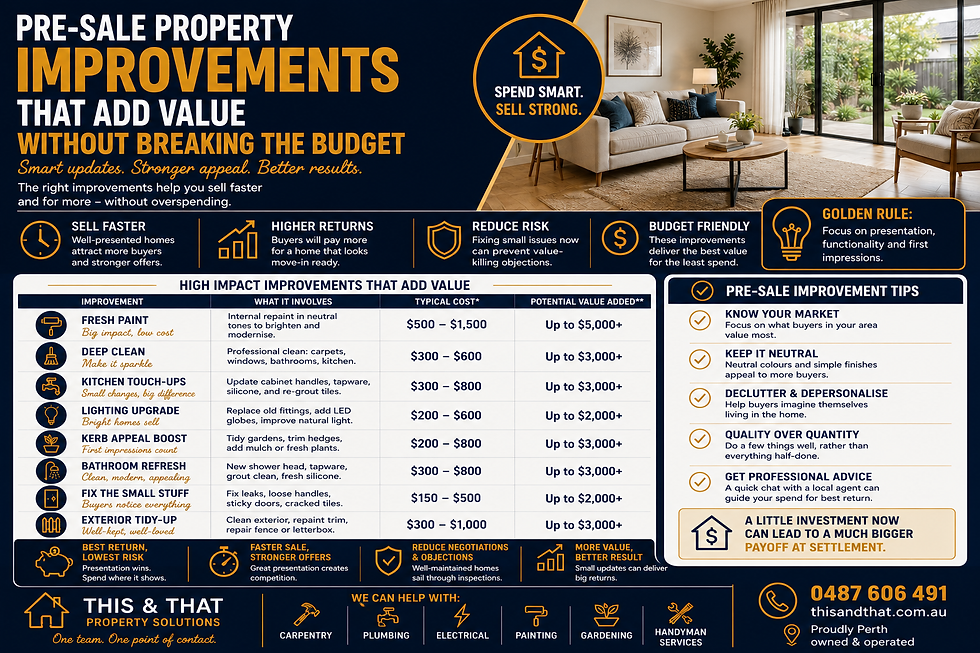
Fresh paint throughout. Interior painting is the highest-return pre-sale improvement in almost every price bracket and every suburb. A fresh, neutral palette makes rooms feel larger, cleaner and more move-in ready. Buyers mentally subtract the cost of painting from their offer when walls are marked, faded or painted in colours that don't appeal broadly. Spending on interior paint before listing almost always returns more than it costs.
Exterior paint is equally important for street appeal. The front of the property is the first thing buyers see in listing photos and in person. A freshly painted exterior signals that the property has been looked after, which builds buyer confidence before they've even walked through the door.
Flooring. Old carpet is one of the most common reasons buyers mentally reduce their offer. Worn, stained or dated carpet reads as neglect even when everything else is in good order. Replacing it with a quality vinyl plank or hybrid floor is generally worth the spend. Existing timber floors that are in reasonable structural condition can often be sanded and refinished for significantly less than full replacement.
Kitchen refresh without full renovation. A full kitchen renovation before a sale is often overcapitalising unless the existing kitchen is genuinely poor and the property's price point supports the spend. In most cases, a targeted refresh delivers more return for less outlay. New benchtops, updated tapware, a fresh splashback, new cabinet handles and a coat of paint on the walls can transform a kitchen's appearance for a fraction of the cost of new cabinetry. Buyers respond to a kitchen that feels clean and current — they don't necessarily need it to be brand new.
Bathroom refresh. The same principle applies to bathrooms. New tapware, a fresh vanity, clean regrouting, a reseal on the shower screen and fresh paint take a tired bathroom to presentable for considerably less than a full renovation. If the tiles are in reasonable condition, cleaning and regrouting them is far cheaper than retiling and achieves most of the visual benefit.
Lighting updates. Replacing outdated light fittings with clean, modern LED downlights is inexpensive and makes a meaningful difference to how rooms photograph and present at inspection. Well-lit rooms feel larger and more appealing. All electrical work must be carried out by a licensed electrician registered with EnergySafety WA.
Street appeal. Mow, edge, weed, prune, pressure wash the driveway and paths, replace a broken letterbox, paint the front fence if it needs it and make sure the front door looks cared for. Buyers and their agents form a strong first impression before they get out of the car. Street appeal improvements cost relatively little and return disproportionately in buyer confidence.
Repairs and maintenance. A building inspector engaged by a buyer will identify every maintenance issue the property has. Buyers use pre-purchase inspection reports to negotiate price reductions or to walk away entirely. Going through the property systematically before listing and fixing the things an inspector would flag — dripping taps, sticking doors, cracked grout, damaged fly screens, gutters that need clearing, fence panels that are broken — removes that negotiating ammunition from the buyer's hands. It's almost always worth doing.
What tends to overcapitalise
Full kitchen or bathroom renovation in a mid-market property. If the property's likely sale price doesn't support a premium finish, spending $25,000 on a kitchen renovation before listing will not return $25,000 in the sale price. Buyers in each price bracket have an expectation of finish — they won't pay above that expectation simply because the kitchen is nicer than comparable properties at the same price.
Premium landscaping. Significant garden landscaping rarely returns its full cost at sale. Buyers who love gardens want to create their own. Buyers who don't care about gardens won't pay a premium for one. A tidy, well-presented garden is worth doing. An elaborate landscaping project before a sale generally isn't.
Swimming pools. Adding a pool immediately before a sale is almost never a good financial decision. Pools are a divisive feature — some buyers value them highly, others see them as a maintenance liability. The cost of installation rarely returns in the sale price, and the timeline for installation typically doesn't align with a pre-sale project.
Highly personalised improvements. Improvements that reflect strong personal taste — bold feature walls, unusual tile choices, high-end finishes in non-standard colours — tend to narrow the buyer pool rather than expand it. Pre-sale improvements should appeal broadly, not specifically.
Compliance issues that need to be addressed before sale
Some maintenance and compliance issues are not optional before a property is sold. In Western Australia, vendors are required to make certain disclosures under the Property Law Act 1969 (WA) and related legislation. A solicitor or settlement agent can advise on the specific disclosure obligations for your property.
Compliance issues that frequently arise at the point of sale include:
Pool barrier compliance. Pool and spa barriers must comply with Australian Standard AS 1926 and are subject to inspection. A non-compliant pool barrier is a serious issue that needs to be resolved before settlement. The Building and Energy division of DMIRS provides guidance on pool barrier requirements in WA.
Unlicensed building work. Building work carried out without the required approvals or by unlicensed trades creates disclosure obligations and can affect the sale. A pre-sale building inspection will identify this. It is far better to identify and address these issues before listing than to have them raised by a buyer's inspector during the negotiation phase.
Asbestos. Homes built before 1990 in Perth have a reasonable likelihood of containing asbestos materials. Vendors are not required to test for asbestos, but they are required not to make false representations about the property's condition. The Asbestos Safety and Eradication Agency has useful guidance on identifying and managing asbestos in residential properties. Any asbestos removal must be carried out by a licensed asbestos removalist under WorkSafe WA regulations.
Getting the timing right
Pre-sale improvements need to be completed before the property is photographed for listing. Listing photos are the primary marketing asset — they determine how many buyers come through the door. Photos taken before improvements are complete, or in a property that still has works in progress, are counterproductive.
Allow enough time for the work to be done properly. Rushed pre-sale renovations frequently result in corners being cut, finishes that look hurried and trades that don't have time to do their best work. A timeline that builds in a week or two of buffer between completion and photography is a sensible approach.
For properties that need multiple improvements across different trade areas, coordinating the work through a single team that handles renovation, plumbing, carpentry and general maintenance together significantly reduces the scheduling complexity and the risk of delays.
This & That handles pre-sale property improvements across Perth — from minor repairs and maintenance through to kitchen and bathroom refreshes, painting preparation and outdoor work. Visit thisandthat.com.au to find out more, request a quote here or call 0487 606 491 to talk through what your property needs before it goes to market.


