
The Real Cost of Deferred Maintenance: What Perth Homeowners Are Actually Paying
There's a particular kind of optimism that comes with owning a property. The dripping tap will get fixed eventually. The fence post that's rocking a bit is probably fine for another season. The stain on the ceiling is old and hasn't gotten any bigger, so it's probably stopped. The door that won't quite latch can be lifted slightly and it closes well enough.
Most of these things feel like minor inconveniences. Some of them are. But a significant number of the expensive property repairs Perth homeowners and landlords face are the direct result of small problems that were noticed, assessed as non-urgent and then quietly forgotten about until they became impossible to ignore.
Deferred maintenance isn't free. It's a loan with compounding interest. The longer you leave it, the more it costs.
Why small problems become expensive ones
The pattern is consistent across almost every category of property repair. A problem at its earliest stage is cheap to fix. The same problem six months or two years later is a different job entirely.
A dripping tap washer costs very little to replace. Left dripping, it wastes thousands of litres of water a year according to the Water Corporation of WA, and the constant moisture around the tap body eventually damages the tap itself, the cabinet below and sometimes the wall or floor behind it. A tap washer replacement becomes a tap replacement, a cabinet repair and potentially a wall repair.
A cracked roof tile lets in a small amount of water during heavy rain. The water sits in the ceiling space, wets the insulation, softens the plasterboard and eventually shows up as a stain on the ceiling. By that point, the tile repair that might have cost a few hundred dollars has been joined by insulation replacement, ceiling repair and repainting. If the water has tracked further, there may be timber damage in the roof structure as well.
A fence post that's rotting at ground level will eventually fail. If it fails during a strong Perth easterly, it takes the fence panels with it. Replacing a post proactively is a fraction of the cost of replacing a section of fence after it's been blown down, plus the emergency callout, plus whatever it's damaged on the way down.
The same pattern applies to blocked gutters that overflow into the fascia, shower grout that allows water behind tiles, hot water systems that are kept running past their service life and external paint that's allowed to fail before the timber below is protected.
The categories where deferral costs most
Some maintenance categories are more forgiving than others. Deferred garden maintenance looks bad but doesn't usually compound into a structural problem. The categories below are the ones where deferral reliably becomes expensive.
Water and moisture. Water finding its way into a building is the single most destructive maintenance problem in residential property. It damages timber, promotes mould, degrades insulation, weakens plasterboard and, in serious cases, affects structural elements. Perth's occasional heavy winter rainfall means that any gap in the building envelope, whether in the roof, around windows, through failed caulking or through cracked render, gets tested regularly. Finding and fixing these gaps while they're small is significantly cheaper than dealing with the damage after water has been tracking through for a season or two.
Timber rot. Timber that is exposed to consistent moisture rots, and once rot is established it spreads. A small area of rot in a weatherboard, a fence post or a decking joist that is caught early can often be cut back and the affected section replaced. The same rot left for another year involves replacing more timber, and left another year after that may involve structural repairs. In Perth's climate, timber that is unpainted, unsealed or in ground contact is particularly vulnerable.
Roof and gutters. Problems at the top of the building affect everything below. A gutter that is blocked and overflowing directs water into the fascia and soffit. A fascia that is saturated rots. A roof space that is taking water damages insulation and eventually ceiling linings. The Department of Fire and Emergency Services WA also notes that leaf-filled gutters are a significant fire risk in Perth's bushfire-prone areas, adding another dimension to the cost of not cleaning them.
Hot water systems. Hot water systems that are kept running beyond their service life don't usually fail gradually. They tend to fail completely, often at an inconvenient time, and a complete failure means emergency replacement rather than a planned upgrade. The cost difference between a planned hot water system replacement and an emergency one, including after-hours callout rates, is meaningful. More significantly, a leaking tank that isn't identified quickly can cause water damage to the surrounding area before anyone notices.
Plumbing leaks. Hidden leaks are the most insidious category of all because the damage accumulates invisibly. A slow leak behind a wall or under a floor can run for months before it shows up as a visible stain, a soft patch on the floor or a mould problem in a room that's otherwise dry. By that point, the wall lining, insulation and potentially the structural timber have been affected. The Water Corporation of WA recommends checking your water meter periodically for unexplained movement as an early detection method.
Electrical systems. Electrical faults that are ignored don't just stop working. They can cause fires. A power point that feels warm, a safety switch that trips repeatedly or a light fitting that flickers are all signs of a problem that needs a licensed electrician registered with EnergySafety WA. The cost of an electrician to investigate and fix a fault is substantially less than the cost of fire damage, and that's before considering the human safety dimension.
What deferred maintenance costs landlords specifically
For landlords, deferred maintenance has consequences that go beyond the repair cost itself.
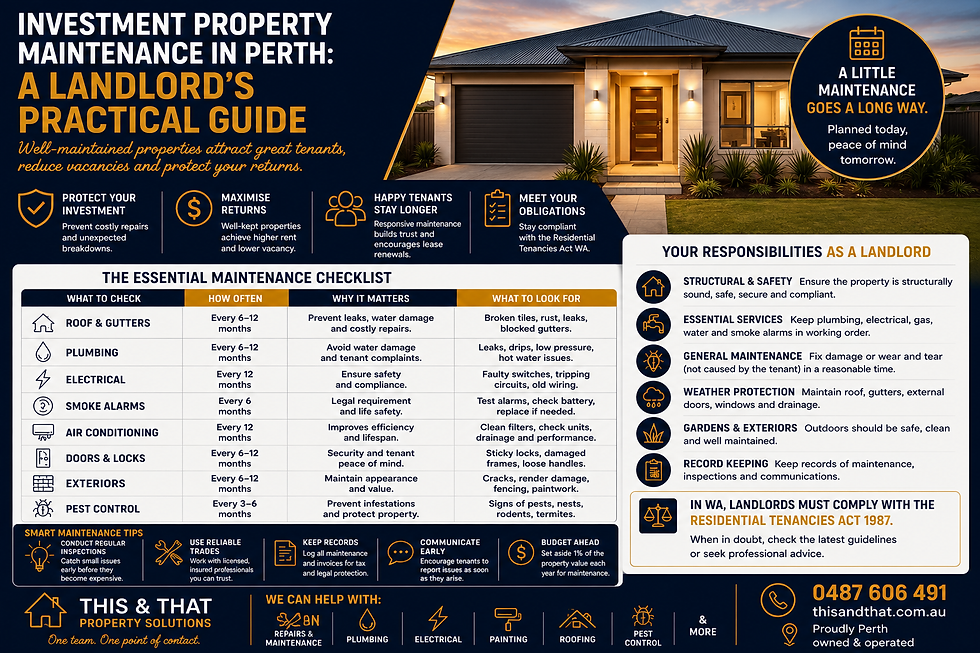
Under the Residential Tenancies Act 1987 (WA), landlords are required to maintain premises in a reasonable state of repair. The Consumer Protection division of DMIRS is clear that this obligation is ongoing throughout the tenancy, not just at the point of signing a lease.
A landlord who fails to address maintenance issues faces several practical risks beyond the repair itself. Tenants who feel maintenance is being ignored are more likely to leave at the end of their lease, creating vacancy periods. In a market where good tenants are worth keeping, this is a real cost. Tenants also have the right under WA law to apply to the State Administrative Tribunal (SAT) to have maintenance disputes resolved, which adds time, stress and potential cost to a situation that could have been avoided.
Poor maintenance also affects the long-term capital value of the property. A well-maintained investment property holds its value and attracts stronger rental returns. A property where maintenance has been deferred shows up clearly to buyers and valuers and is reflected in the price.
What deferred maintenance costs at the point of sale
Properties heading to market with deferred maintenance face two problems simultaneously. Buyers doing due diligence identify the issues and either discount their offer or walk away. And the vendor, having decided to sell, now needs to fix things quickly rather than thoughtfully, which almost always costs more than addressing them in a planned way would have.
A pre-purchase building inspection is standard practice for Perth buyers. An inspector who finds multiple maintenance issues, even minor ones, signals to the buyer that the property hasn't been looked after. The cumulative effect on buyer confidence tends to be disproportionate to the actual repair cost involved.
According to REIWA (Real Estate Institute of Western Australia), well-presented and well-maintained properties consistently achieve stronger results and shorter selling periods in Perth's market. The work done to maintain a property over time pays a return at the point of sale as well as throughout the ownership period.
A practical approach to staying ahead of it
The most effective way to manage property maintenance is to treat it as a scheduled activity rather than a reactive one. An annual inspection that works through the property systematically, identifies what needs attention and addresses it before it becomes urgent is considerably cheaper and less stressful than managing a series of reactive repairs.
For homeowners, building a relationship with a reliable handyman and trades team means maintenance gets done promptly rather than deferred because finding someone is too much effort. For landlords managing multiple properties, having a single team that handles a range of maintenance work across all properties simplifies the process considerably.
The Building and Energy division of DMIRS provides guidance on what maintenance work requires a licensed professional in WA. Electrical, plumbing, gas and structural work all require the appropriate licence. General maintenance, carpentry repairs, painting and outdoor work can be handled by a skilled handyman.
This & That provides property maintenance, repairs and renovation work across Perth for homeowners and landlords. Visit thisandthat.com.au to find out more, request a quote here or call 0487 606 491 to talk through what your property needs.


